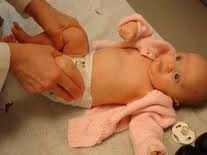
Why hip screening matters
A hip that is recognised very early (by 4 weeks of age at the latest) and treated properly can heal completely.
Hip dysplasia
Hip dysplasia is much more common and is also usually present from birth. The hip joint does not develop quite normally, and typical changes form in both the socket and the thigh bone – importantly, the head of the thigh bone still sits in the socket and is not dislocated. When an infant is examined, several minor or major signs can point to dysplasia; if it is suspected, an ultrasound scan is needed.
Screening matters because dysplasia does not have symptoms as typical as a dislocation. Starting treatment early is very important here too, because up to 3–4 months of age the hip joint is very flexible and responds extremely well to treatment.
Treatment
Treatment depends on what the ultrasound shows. Minor changes can be cured completely with hip exercises. For moderate changes, exercises are combined with an abduction (spreader) pant. In more severe cases a strap harness (Pavlik harness) is needed, which holds the legs in the position best for the development of the hip joint.
The earlier the problem is recognised and treated, the shorter the time in the Pavlik harness.
Videos: Infant hip dislocation and hip dysplasia
Links open on YouTube in a new tab. The videos give general information and do not replace a personal examination.