Meniscus injury and tear
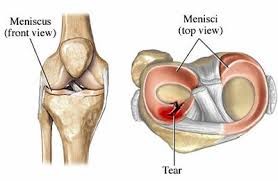
There are two menisci in the knee joint. The inner (medial) meniscus is one of the most easily injured parts of the knee; the outer one is injured much less often. In children and young adults it typically tears in a sports injury or traffic accident, while in older people a degenerative tear without any real injury is more common.
A torn meniscus hurts at the site of the tear when you put weight on the leg. If the torn part slips into the joint, the knee “locks” and cannot be fully straightened, and sooner or later the loose piece damages the cartilage surface of the knee, starting cartilage wear. That is why knee arthroscopy is recommended if it has not healed within 6–8 weeks: usually the torn piece is removed and the area smoothed, and occasionally it can be stitched back.
Cruciate ligament tear
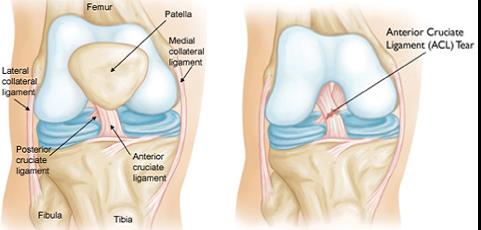
There are two cruciate ligaments in the knee joint, and the front (anterior) one is relatively vulnerable. Twisting the knee during sport often tears the anterior cruciate ligament (ACL) – the knee swells, becomes painful and later noticeably unstable.
If the ligament is completely torn, the knee becomes unsuitable for most sports, and surgical reconstruction of the ligament is the solution. Recovery after this operation is relatively long (3–6 months).
Pain around the kneecap
The back of the kneecap is covered with cartilage that forms a separate joint surface. This surface can be damaged by repeated overload, injury or an inherited weakness of the cartilage. Typical symptoms: difficulty walking downstairs, a dull, tight pain behind the kneecap after sitting for a long time with the knee bent, and painful squatting and kneeling.
Cartilage supplements in tablet form play a large part in treatment; if they do not resolve the complaints, the next option is a course of cartilage-replacing (hyaluronic acid) injections into the joint.
Cartilage detachment, loose body in the knee
A piece of cartilage, or of cartilage and bone, quite often breaks off in the knee joint. It may stick inside the joint or float freely in the joint fluid as a loose body. If it slips between the weight-bearing cartilage surfaces it can lock the joint: the knee catches at a certain point of movement.
Treatment is surgical removal of the fragment; in the vast majority of cases this can be done arthroscopically, but sometimes the knee joint has to be opened.
Recurrent dislocation of the kneecap
The first dislocation of the kneecap is often caused by an accident, but sometimes it pops out after an awkward movement. The first dislocation is quite likely to be followed by a second and further ones, more and more often but with less and less pain – this is called recurrent dislocation. After a first dislocation with significant swelling or a detached piece of cartilage, arthroscopy is needed; for milder complaints, strict rest or immobilising the knee for a few weeks may be enough.
Baker's cyst behind the knee
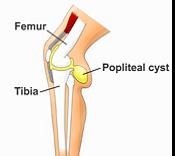
A tense sac can form behind the knee that makes bending the knee difficult and painful – this is called a Baker's cyst. The cyst is never a condition in its own right; it forms because of pressure from increased fluid in the knee joint, causing a typical swelling behind the knee that is easy to feel.
Since the cause is always excess fluid production in the knee joint, treatment is mainly aimed at that – if the joint inflammation can be reduced, the cyst shrinks on its own and may even disappear. Surgical removal is only recommended if it causes severe complaints or is very large.
Videos: Knee joint conditions
Links open on YouTube in a new tab. The videos give general information and do not replace a personal examination.