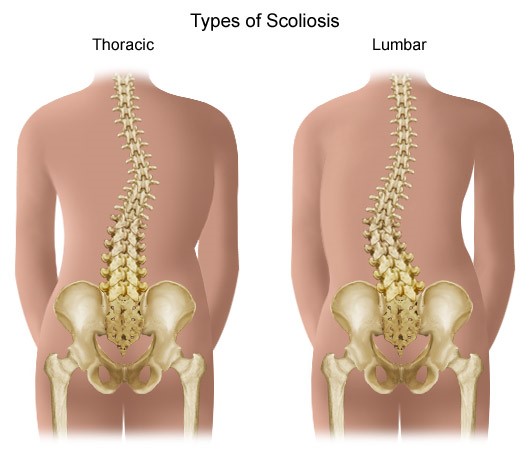
Signs
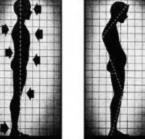
- The head is not in line with the body.
- One shoulder or hip is higher than the other.
- Limping.
- Back pain.
- Getting tired quickly during work that involves a lot of chest or trunk movement.
Possible complications
The most important complication is joint wear (osteoarthritis) due to uneven loading of the joints, mainly between the vertebrae and in the knee and hip joints. In later life, restricted lung movement and breathing can also lead to heart failure (cor pulmonale).
Causes
In 85% of cases the cause of scoliosis is unknown (idiopathic scoliosis). The remaining cases fall into two groups: in functional scoliosis the sideways curve is a temporary condition caused by another illness (e.g. appendicitis), and the spine itself is healthy. In structural scoliosis the spine is deformed; the cause may be a developmental abnormality, muscle wasting, a metabolic disease or a connective tissue disorder.
What you can do
The most important things are early recognition and starting treatment as soon as possible. Early detection of scoliosis is the job of an orthopaedic specialist, and it is important that every child has regular check-ups.
Treatment options
In most cases scoliosis does not need treatment. Strengthening the back muscles is important, mainly through regular swimming and physiotherapy. If the curve is less than 20 degrees, a check-up every six months is recommended; for a curve of 20–25 degrees, wearing a brace may be justified. Surgery is considered once the curve reaches 45–50 degrees – the joints between the vertebrae are fused so that the curve is reduced, and a metal rod may need to be placed alongside the spine.
Because the cause is usually unknown or cannot be cured effectively, scoliosis cannot be effectively prevented – only secondary prevention is possible: regular check-ups, strengthening the back muscles and other treatment if needed. It is especially important to detect scoliosis in young children in time, as these cases are most prone to rapid worsening.
Videos: Scoliosis
Links open on YouTube in a new tab. The videos give general information and do not replace a personal examination.