Trigger finger (digitus saltans)
It develops from long-lasting inflammation of a finger's flexor tendon or scarring of the ring-shaped ligaments (pulleys) that hold the tendon down. A swelling or nodule forms on the tendon, and a snap can be felt when the finger is bent and straightened, as the nodule jumps over the scarred band. In more severe cases the finger “gets stuck” bent or straight and can only be snapped back with the other hand.
Because the scarring has already formed, surgically releasing the scarred pulley is always justified. The operation can be done under local anaesthesia as day surgery.
Nerve entrapment (tunnel syndrome)
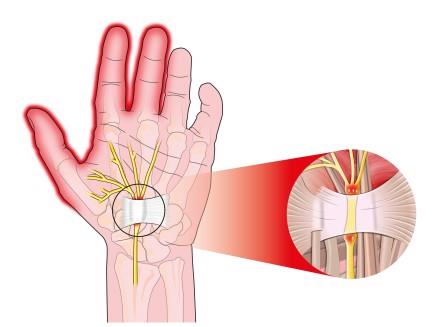
This means numbness caused by a nerve being compressed. The two nerves responsible for sensation in the hand are most often affected: the ulnar nerve is compressed mainly by scarring at the elbow (causing numbness in the little and ring fingers), and the median nerve is compressed at the wrist (carpal tunnel syndrome), causing numbness, reduced sensation and pain in the thumb, index and middle fingers.
Nerve entrapment can usually be identified well by a medical examination; in doubtful cases a nerve conduction study (ENG) may be needed. Surgically releasing the compressing structures and freeing the nerve is always justified, as otherwise permanent nerve damage can develop. The operation can be done under local anaesthesia as day surgery.
Contracture of the fingers (Dupuytren's contracture)
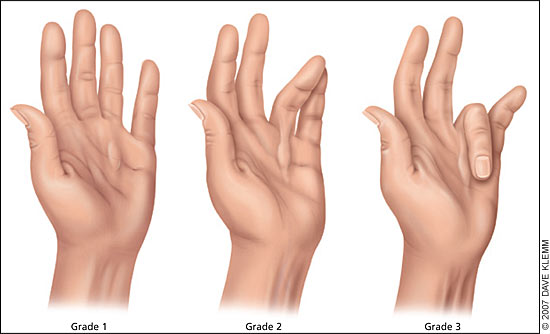
It is caused by a disease of the strong layer of connective tissue in the palm. Scarred nodules first appear in the fibres of this layer, not always painful; then the fibres start to shorten lengthwise and pull the fingers towards the palm so they can no longer be fully straightened.
The operation requires complete removal of the scarred cords and nodules. With marked contracture, plastic surgery on the skin of the palm is sometimes also needed, which lengthens healing. In simpler cases, full healing takes 3–4 weeks.
Tendon sheath inflammation (tenosynovitis)
Inflammation of the tendon sheath is not unusual in the hand. Our hands are sometimes put under very heavy strain, and the protective sheath around the tendon can become inflamed. Moving the wrist or the affected fingers causes strong, sharp, tearing pain.
It usually responds well to rest, compresses, anti-inflammatory ointment and physiotherapy. Sometimes a resting splint is needed, and in more severe cases an anti-inflammatory injection into the tendon sheath.
If the complaints do not ease even after months, surgery may be needed: opening the scarred, inflamed tendon sheath, which can also be done as day surgery. Full healing takes 3–4 weeks.
Ganglion
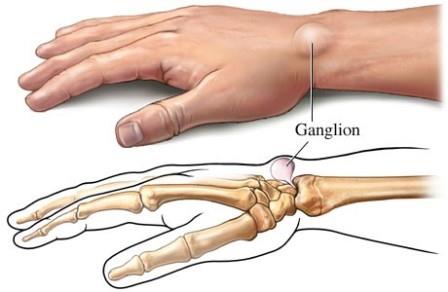
A pea- to bean-sized, usually painful, firm swelling on the wrist or fingers is called a ganglion – a pouch bulging out of the joints of the wrist or fingers (or sometimes the tendon sheath), filled with thick, jelly-like fluid.
Without treatment it rarely disappears, but if it is painless it does not necessarily need removing; temporary use of a resting splint and a local anti-inflammatory cream are enough. If it causes discomfort or pain, surgical treatment is justified, which can be done as day surgery.
Videos: Hand conditions
Links open on YouTube in a new tab. The videos give general information and do not replace a personal examination.