Tennis elbow (lateral epicondylitis)
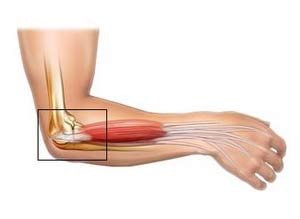
Strong pain on the outer side of the elbow, caused by overloading the extensor muscles of the forearm. When these muscles are overloaded, inflammation of the bone lining develops where they attach, and this causes the pain. It is common among people who type a lot, do heavy physical work or play tennis. The typical symptom is sharp, sometimes very intense elbow pain when moving the hand, gripping or lifting it upwards.
It can be diagnosed very reliably by a medical examination; imaging is usually not needed. Treatment aims to calm the irritated bone lining: in milder cases an anti-inflammatory ointment, rest and a sling are enough, and physiotherapy also works well. For marked pain, the inflamed area can be injected, which brings quick and strong improvement in the vast majority of cases. If lasting improvement cannot be achieved any other way, surgery can be considered as a day-surgery procedure.
Golfer's elbow (medial epicondylitis)
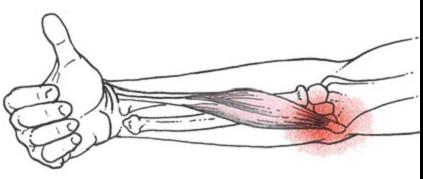
A condition similar to tennis elbow, but here the pain is on the inner side of the elbow and is caused by overloading the flexor muscles of the forearm. It is less common and develops mainly from forceful gripping. Treatment follows the same principles as for tennis elbow – applied to the inner side, of course – and surgery is only very rarely needed for this condition.
Cubital tunnel syndrome
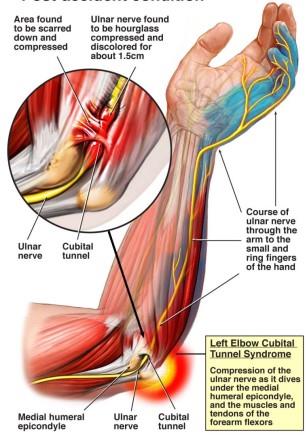
Scarring or inflammation of the soft tissue can develop around the tip of the elbow, and the tension of the surrounding tissue compresses the ulnar nerve. This causes moderate elbow pain along with numbness and loss of sensation in the little and ring fingers.
Numbness in the fingers may also be caused by a problem in the neck (a nerve root), and a nerve conduction study (ENG) may be needed to rule this out. If impaired conduction of the nerve at the elbow is confirmed, usually only surgical release of the nerve gives a good result. Full healing takes 2–3 weeks.
Elbow pain radiating from the neck (radicular pain)
The nerves of the arm branch off from the cervical spine. If the nerve roots are compressed, numbness, pain and reduced sensation can appear in the area they supply – sometimes precisely around the elbow, when it can be mistaken for cubital tunnel syndrome. In such cases a nerve conduction study (ENG) identifies the cause, and treatment is directed at the cervical spine.
Videos: Elbow pain
Links open on YouTube in a new tab. The videos give general information and do not replace a personal examination.